Gowago / Case study
Delivery, made clear
A clearer journey from order to handover, with live updates and less manual coordination.

- My role
- Product designer
- Timeline
- Feb–Apr 2023
- Team
- 1x Product Manager, 2x Developers, 2x Delivery Specialists
The sale was guided.
The wait wasn’t.
Gowago’s digital leasing journey guided customers through their application step by step. After the sale, that clarity disappeared: customers couldn’t see their delivery status or expected date, and had to call the delivery team for updates.
As delivery volume grew, the team struggled to keep up with questions. Information was scattered across emails, notes, and systems, making it difficult to cover for absent colleagues or give every customer a consistent experience.
“I felt forgotten after the sale.”Customer
One journey.
Two sides of the problem.
We started by observing the delivery team’s processes and interviewing stakeholders. Together, we explored how updates were handled and where information became difficult to retrieve.
We then explored the customer perspective through nine interviews at the point of delivery. Analysing these experiences revealed a gap between the guided sales process and the uncertainty that followed.
Customers needed visibility.
Current status and the expected delivery date were the biggest gaps. Required documents and next steps were also unclear.
Updates depended on people.
Customers called for information that wasn’t available digitally, adding repeated coordination work as delivery volume grew.
Continuity was fragile.
With information spread across different places, team absences made it harder to retrieve updates and provide consistent support.
Connect the update
to the work behind it.
The research pointed to a connected service: customers needed a reliable place to check progress, while the team needed the same delivery steps reflected in its working tools.
We grouped pain points and opportunity areas in an affinity map, then translated them into a blueprint-style wireflow connecting the customer experience with the team’s internal process.
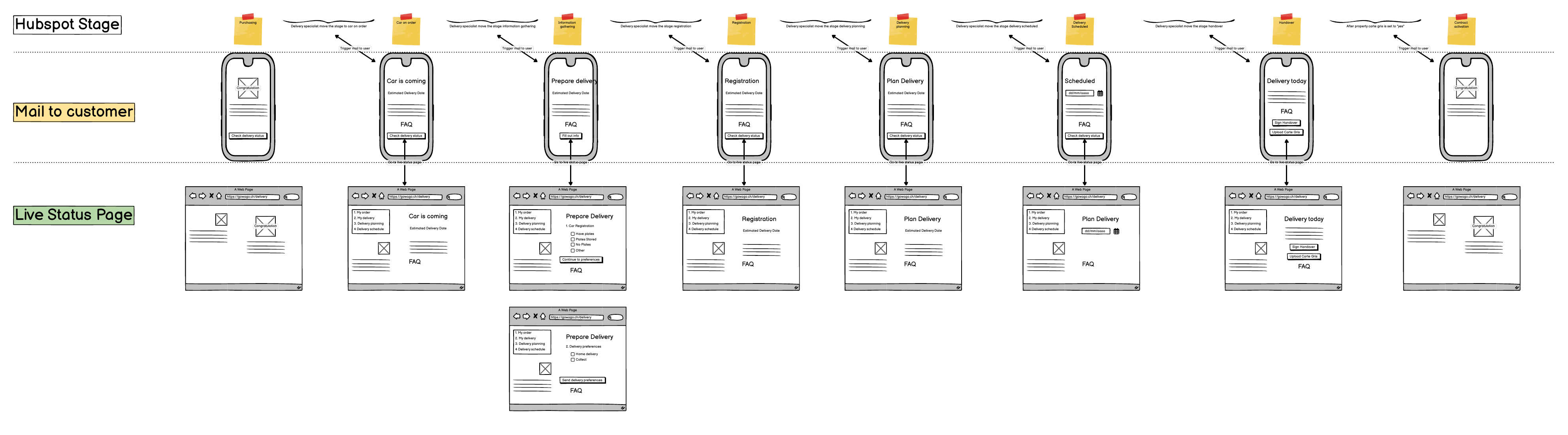
For customers: automated notifications and a live status landing page with updated delivery information and clear next steps.
For the delivery team: the same steps mirrored in a HubSpot funnel, with triggers and properties connecting internal progress to customer-facing updates.
By connecting customer updates to the operational workflow, we addressed both the lack of visibility and the team’s need for more consistent information.
More clarity.
Less coordination.
Post-launch evaluation included a survey of 100 customers and follow-up interviews.
Car ordered
Your Audi A3 Cabriolet is on the way!
The estimated delivery date for your car is between 10.12.2022 and 30.12.2022.
Your car is on order. I’ll get in contact with you when your car is about to arrive.
Contact delivery teamFAQ
Information gathering
Your Audi A3 Cabriolet is on the way!
The estimated delivery date for your car is between 10.12.2022 and 30.12.2022.
Delivery preference
How would you prefer to receive the car?
FAQ
Happy driving!
Now, just enjoy the driving of your car.
gowago.ch is happy to assist you throughout the duration of your lease.
Contact customer servicePopular articles
1 / 3 · Car ordered